

Tried fiber, water, and laxatives but you’re still stuck? Chronic constipation is rarely just IBS-C. Use this clear Diagnosis Map to identify your real root cause – SIBO, Pelvic Floor Dysfunction, or a dysregulated nervous system-and learn the exact steps to heal.
If you’re reading this, your search history probably looks like mine did for 15 years:
- “chronic constipation remedies”
- “why does fiber make my bloating worse”
- “laxatives not working anymore”
- “constant bloating and anxiety”
You’ve tried the fiber supplements, the gallons of water, the yoga poses, the over-the-counter laxatives that eventually lose their effect. You’ve been told it’s “just IBS-C” and to “manage your stress.”
And you’re still stuck.
I spent over a decade in that exhausting, demoralizing loop. The breakthrough didn’t come from another supplement. It came from a brutal but liberating realization:
“Chronic constipation” is not a diagnosis. It’s a symptom.
Trying to treat it without knowing the root cause is like trying to fix a constantly ringing fire alarm by removing the battery. You silence the noise, but you leave the fire completely unchecked.
True healing began when I stopped asking “How do I make this stop?” and started asking “Which system is actually broken?”
From my own journey and the science, I found there are three primary systems that, when dysfunctional, create the exact same symptom of relentless constipation. I turned this into a simple Diagnosis Map. Your path to getting unstuck starts by finding your branch on this tree.
The Chronic Constipation Diagnosis Map
This map outlines the three distinct pathways. You may see yourself in one branch primarily, or in a combination (this is very common).
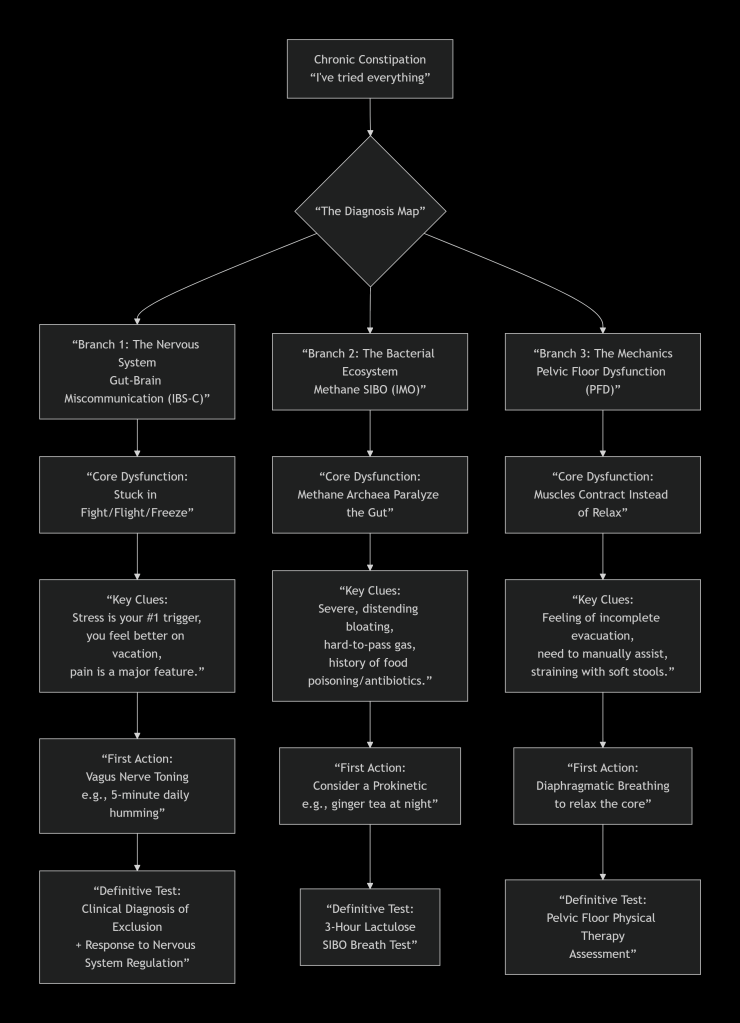
Branch 1: The Nervous System Pathway (Gut-Brain IBS-C)
This is where anxiety, trauma, and chronic stress manifest physically. Your gut is hypersensitive because your nervous system is stuck in a survival state (sympathetic “fight/flight” or dorsal vagal “freeze”), directly inhibiting the migrating motor complex—your gut’s natural cleansing wave [1].
Your Key Clues:
- Your symptoms are your personal stress barometer. A bad day at work or a difficult conversation guarantees a gut shutdown.
- You experience noticeable relief on vacation or during truly calm periods.
- Abdominal pain and cramping are significant and often relieved after a bowel movement.
- You identify with feeling “wired but tired” or emotionally numb.
The First Step Off This Branch:
Don’t target the gut first. Target the state of your nervous system. Your foundational practice is vagus nerve toning. Try this: lie down, place a hand on your belly, and hum a low tone (like “om”) for 2-3 minutes, feeling the vibration in your chest. This simple act stimulates the vagus nerve, signaling “safety” to your gut.
Branch 2: The Bacterial Ecosystem Pathway (Methane SIBO)
Small Intestinal Bacterial Overgrowth (SIBO), specifically the methane-producing type (Intestinal Methanogen Overgrowth or IMO), is a primary driver of treatment-resistant constipation [2]. Archaea microbes produce methane, which slows intestinal transit to a crawl.
Your Key Clues:
- Severe, distending bloating that progressively worsens throughout the day. You may avoid going out in the evenings.
- Gas that is difficult or painful to pass.
- A history of food poisoning, frequent antibiotic use, or long-term PPI (acid reducer) use.
- You may have tried low FODMAP diets with only partial or temporary relief.
The First Step Off This Branch:
You need data, not guesswork. The gold-standard test is a 3-hour lactulose breath test. I specifically recommend the Trio-Smart Breath Test because it’s the only one that measures hydrogen, methane, and hydrogen sulfide gases, giving you a complete picture. While you arrange testing, a gentle nightly prokinetic (like ginger tea or a supplement containing ginger/artichoke extract) can support your gut’s motility until you can address the overgrowth directly.
Branch 3: The Mechanical Pathway (Pelvic Floor Dysfunction)
This is the most overlooked root cause. Your pelvic floor muscles must relax and coordinate to allow a bowel movement. In pelvic floor dyssynergia, they contract when they should relax, creating a functional “logjam” at the exit [3].
Your Key Clues:
- A constant, frustrating feeling of incomplete evacuation.
- Needing to use manual pressure (pressing on your perineum or lower abdomen) to go.
- Straining excessively even when stools are relatively soft.
- A history of traumatic childbirth, chronic sitting, or pelvic/back injuries.
The First Step Off This Branch:
This path requires moving from suspicion to evidence. The clinical gold standard for diagnosis is a 3-hour lactulose breath test, which measures the gases produced by bacteria in your small intestine.
The most important step you can take is to have an informed conversation with a healthcare provider who understands gut health (like a functional medicine doctor or a gastroenterologist). Bring your symptom diary and mention your suspicion of methane SIBO (also called IMO – Intestinal Methanogen Overgrowth) based on your severe bloating and constipation.
While working with a practitioner to get a proper diagnosis and tailored treatment plan, a foundational step everyone can take is to support healthy gut motility. This means encouraging the natural, cleansing waves of your digestive tract. A simple, gentle way to start is with a nightly cup of ginger tea, as ginger is a well-researched natural prokinetic that can help encourage movement without being harsh or stimulant-based.

Your Immediate Action Plan: Stop Guessing, Start Mapping
- Track Your Clues for 3 Days. Use a simple notes app. Don’t just track food; note your stress level (1-10), bloating severity, stool form (Bristol Chart), and unique sensations (e.g., “felt incomplete,” “pain before BM”).
- Find Your Primary Branch. Review the clues above. Which column screams “YES, THAT’S ME!” the loudest? That’s your starting point.
- Advocate for the Right Test. Most doctors default to IBS-C. Come armed with your clues.
- For SIBO Suspicion: “Given my severe bloating and history, I’d like to rule out methane SIBO with a breath test.”
- For PFD Suspicion: “My symptoms point to pelvic floor coordination issues. Can I get a referral to a pelvic floor physical therapist for an assessment?”
📖 From My Journey & Why This Map Exists
I lived in Branch 1 (Nervous System) for years, which created the perfect storm for Branch 2 (SIBO) to take hold. I was told it was “just anxiety.” No one connected the dots. I created this map so you don’t have to waste a decade of your life treating the wrong root cause. Healing became possible only when I addressed my nervous system while treating my SIBO.
A Foundational Support: The One Supplement I Recommend While You Investigate
While you navigate this map, one evidence-based support is magnesium. It acts as an osmotic agent to draw water into the colon and a gentle muscle relaxant. For the investigative phase, I suggest a magnesium citrate powder. It’s effective, and the dose can be easily adjusted. I use and recommend Pure Encapsulations Magnesium Citrate Powder for its purity and predictable results. Start low (half a scoop) and adjust as needed.
(Of course, consult your doctor before starting any new supplement, especially if you have kidney issues.)
You are not broken. You are dysregulated, overgrown, or mechanically stuck. And each of those has a clear, actionable path to resolution.
This Diagnosis Map is your compass out of the confusion. Choose your branch, take the first step, and know that getting the right diagnosis is the most powerful act of self-advocacy—and the true beginning of getting your life, and your gut, moving again.
Written by Ting. I’m a researcher who mapped my own 15-year journey out of chronic constipation. I now help women use science and nervous system principles to find their unique path to gut-brain healing.
Continue Your Healing Journey:
- If Branch 1 resonated: Start with Vagus Nerve 101: How to Calm Anxiety Through Your Nervous System.
- If Branch 2 resonated: Deep dive into Methane SIBO & Constipation: The Science of Why You Feel “Stuck”
References:
- Mayer, E. A. (2011). Gut feelings: the emerging biology of gut-brain communication. Nature Reviews Neuroscience.
- Rezaie, A., et al. (2017). Methane and the Gastrointestinal Tract. Digestive Diseases and Sciences.
- Bharucha, A. E., & Wald, A. (2019). Functional Anorectal Disorders. Gastroenterology.
Your Next Step:
If you’re ready to move from symptom management to nervous-system healing, download my free 7-Day Vagus-Vital Starter Guide. It’s designed for those with anxiety-related IBS-C (constipation) who want a clear, gentle path to digestive ease.
👉 Enter your email below to get instant free-guide access:
Disclaimer: This post shares insights from my 15-year journey with IBS-C and is for educational purposes only. It is not medical advice. Please consult your doctor before making any changes to your diet, supplements, or health routine.

 NeuroSpirit | Science-Backed IBS-C & Chronic Constipation RelieF
Leave a comment