
Stressed and constipated? Learn why your brain’s “fight-or-flight” mode freezes your gut via the vagus nerve. Discover the science behind anxiety-induced constipation and how to reboot your digestion.
Have you ever wondered, “Why am I always constipated, even when I’m eating enough fiber, drinking plenty of water, and doing everything ‘right’?”
You’re not alone. Millions struggle with chronic constipation that defies simple dietary fixes. The missing piece isn’t in your kitchen—it’s in your nervous system.
If you’re someone who feels constantly wound up, anxious, or “on alert,” and your gut feels just as stuck as your thoughts, this is for you. Today, we’re diving deep into the biological link between a stressed brain and a frozen gut: the vagus nerve blockade.
The Desperate Loop: Anxiety, Stress, and a Gut That Won’t Move
First, let’s name the frustrating reality many face:
- You’ve tried the prunes, the extra salads, the gallon water bottles.
- You feel bloated, sluggish, and mentally foggy.
- The harder you try to “fix” your gut, the more anxious you get about it.
- You feel stress in your shoulders, your jaw, and… your silent, unmoving colon.
This isn’t a failure of willpower. It’s a failure of signaling. Your brain and gut are having a communication breakdown, and the main cable connecting them – the vagus nerve – is on mute.
Your Nervous System’s Two Modes: The Real Cause of “Frozen Gut”
To understand the fix, you need to understand the two primary states your nervous system cycles between:
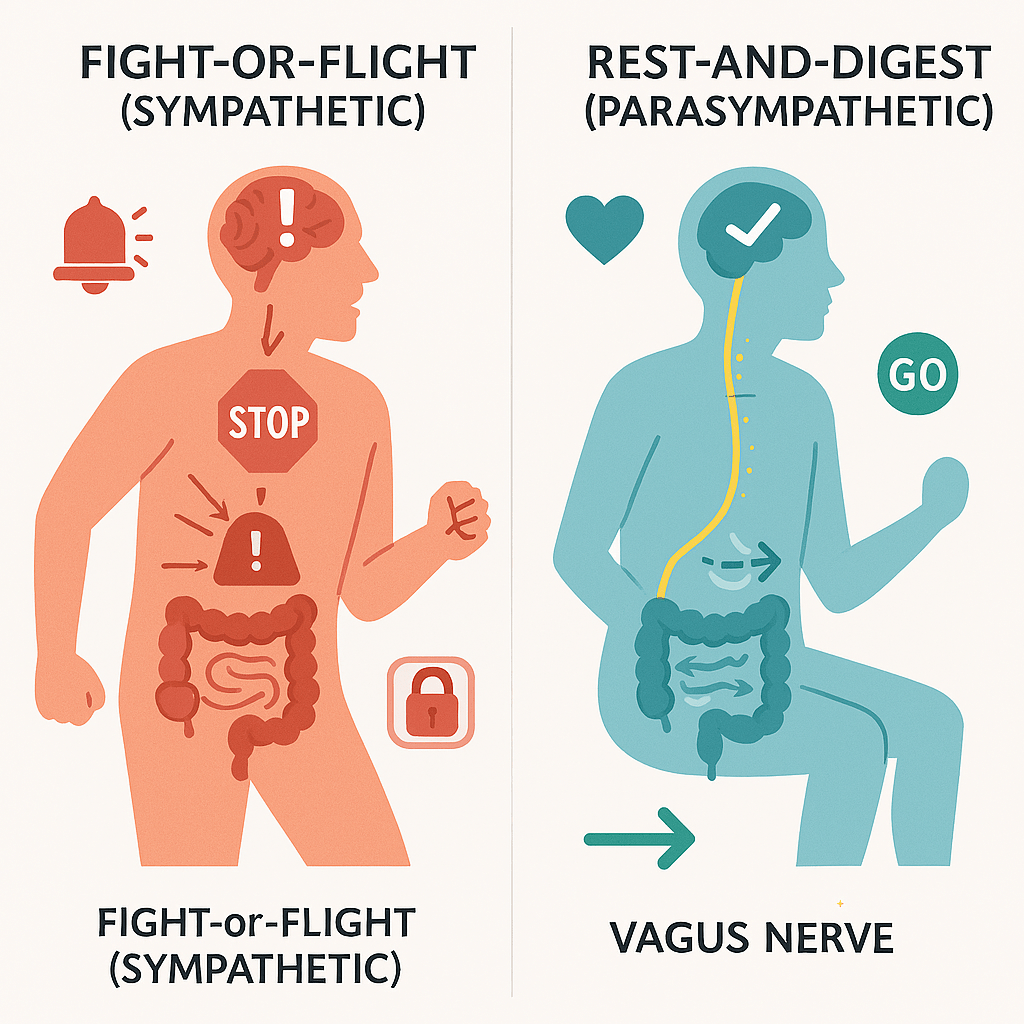
1. Fight-or-Flight (Sympathetic State):
This is your body’s emergency broadcast system. When your brain perceives stress, whether it’s a looming deadline, financial worry, or even chronic anxiety about your health – it flips this switch. Resources are diverted away from “non-essential” maintenance tasks. Your heart rate increases, muscles tense, and yes, digestion completely shuts down. Why? Your body thinks it’s running from a tiger. It doesn’t have time to process lunch.
2. Rest-and-Digest (Parasympathetic State):
This is the state of calm, repair, and, crucially, digestion. When you’re safe and relaxed, your body turns its energy toward long-term projects: healing, immune function, and moving food through your gut. The master conductor of this “Rest-and-Digest” orchestra is the vagus nerve.
The Vagus Nerve: Your Gut-Brain Superhighway (Now Under Construction)
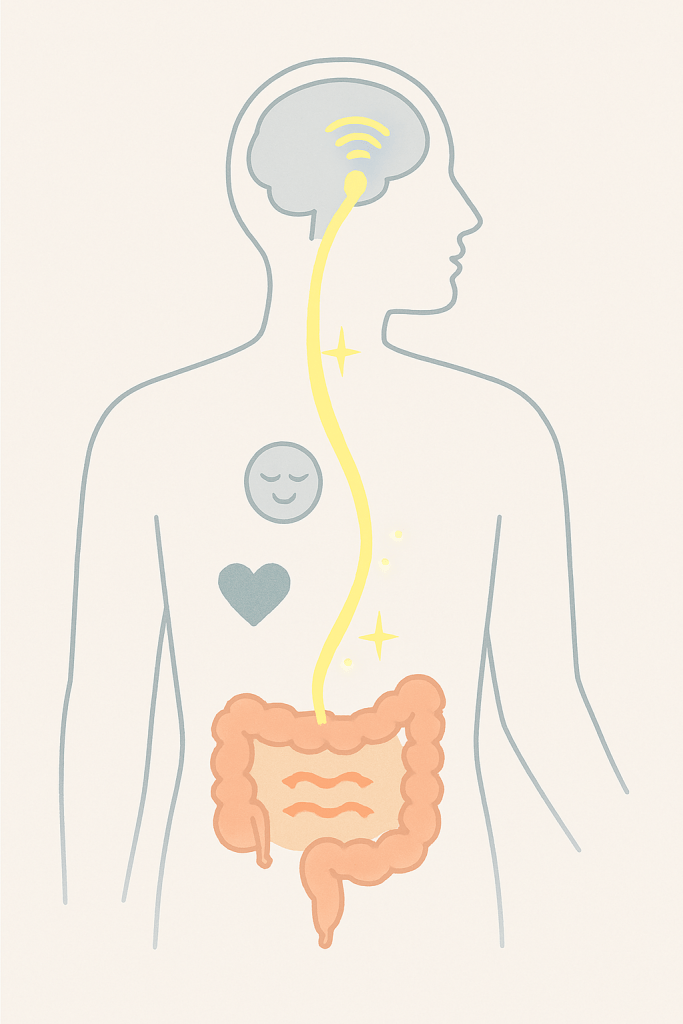
The vagus nerve is the longest cranial nerve in your body. It’s a two-way communication superhighway running from your brainstem to your colon, touching your heart, lungs, and every major digestive organ.
Its job in digestion is simple but vital: to send the “all clear” signal.
When the vagus nerve is toned and active, it’s like a gentle, constant massage for your digestive tract, stimulating muscle contractions (peristalsis) that move waste along. It tells your stomach to release acid and your intestines to process nutrients.
But here’s the blockade: Chronic stress and anxiety suppress vagus nerve activity. It’s like your brain is putting a “DO NOT DISTURB” sign on the door to your gut. No signal goes down. Without that vagal tone, your intestinal muscles get weak and uncoordinated. The result? Sludge-like movement, bloating, and constipation that feels impossible to resolve with food alone.
Why This Feels So Hopeless
This explains why the standard advice often fails:
- More Fiber? If your gut is paralyzed, adding more bulk can just create a bigger traffic jam.
- More Water? Without muscular movement to push things along, water gets absorbed earlier in the tract.
- More Stress: The desperation from not finding a fix adds more anxiety, further suppressing your vagus nerve, tightening the loop.
You’re not broken. You’re stuck in a biological state that prioritizes survival over elimination.
The First Step Isn’t a Supplement—It’s a Signal
The goal isn’t to force your gut to move with harsh stimulants. It’s to switch your nervous system out of “fight-or-flight” and into “rest-and-digest.” You need to manually reset the signal.
Simple, science-backed ways to begin stimulating your vagus nerve today:
- Diaphragmatic Breathing: 5 minutes of deep, slow breaths (inhale 4 counts, exhale 6 counts). This directly activates vagal pathways.
- Humming or Singing: The vagus nerve passes through your vocal cords. Humming creates vibrations that stimulate it.
- Cold Exposure: A splash of cold water on your face or a 30-second cold shower can trigger the “diving reflex,” which boosts vagal tone.
What’s Next? Introducing the Chemical “Off-Switch”
Learning to manually stimulate your vagus nerve is the foundation. But for many whose systems are deeply locked in stress mode, the body needs a clearer biochemical signal to truly relax and reset.
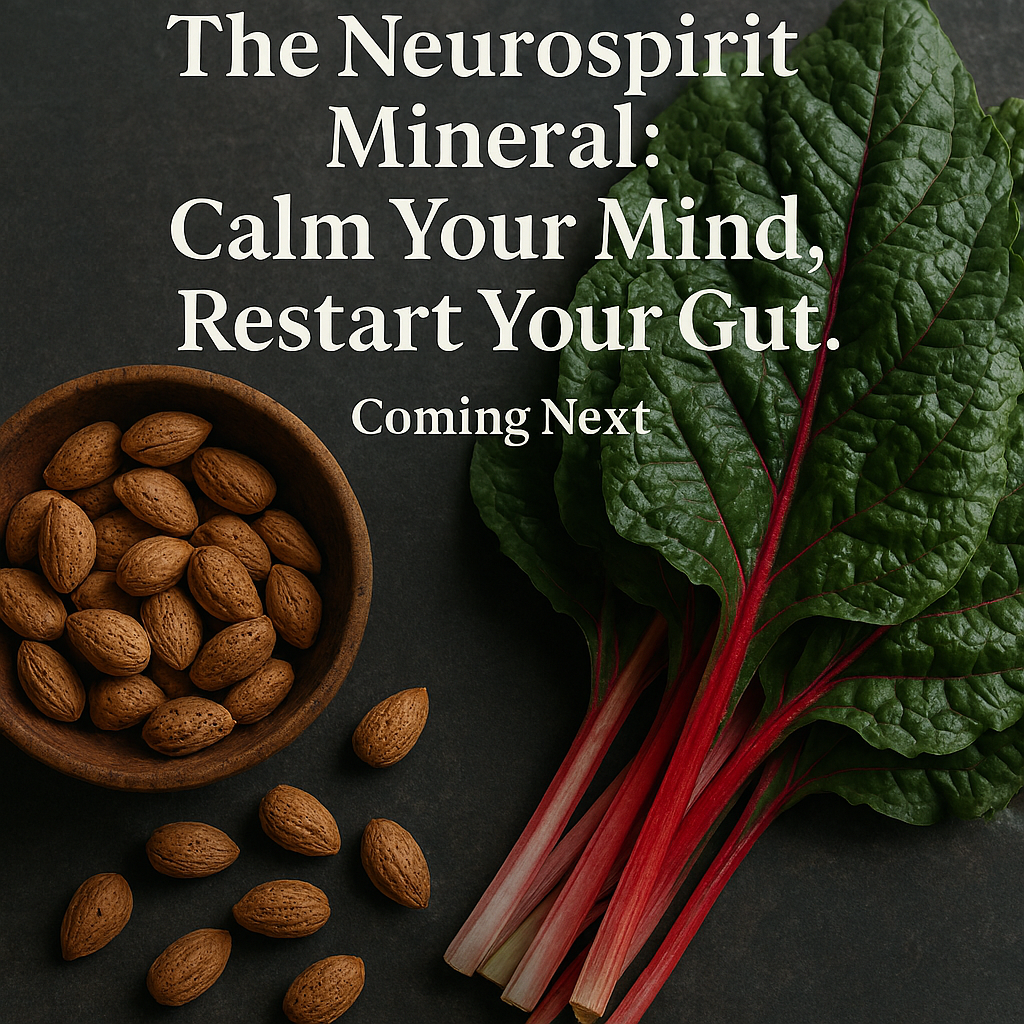
In our next post, we’ll reveal the #1 mineral that acts as your nervous system’s natural “chill pill.” It’s a critical co-factor for hundreds of enzymatic processes, including those that produce calming neurotransmitters and directly relax the smooth muscle of your intestinal tract. It’s the missing key for turning off the “fight-or-flight” alarm at a cellular level, so your vagus nerve can finally do its job.
Want This Sequence Delivered to You?
This is Part 1 of our “Gut-Brain Axis Reset” series. If you’re tired of quick fixes and want to understand the real science of solving chronic constipation from a neurospirit perspective – addressing both the brain and the body – get the next post delivered directly to your inbox.
Subscribe below, and you’ll get:
- Part 2: The specific mineral that signals “rest-and-digest” to your cells.
- Part 3: How to rebuild your gut’s ecosystem for long-term health.
- A free, downloadable guide consolidating all the protocols.
Disclaimer: This post shares insights from my 15-year journey with IBS-C and is for educational purposes only. It is not medical advice. Please consult your doctor before making any changes to your diet, supplements, or health routine.

 NeuroSpirit | Science-Backed IBS-C & Chronic Constipation RelieF
Leave a comment