

Quick Summary: You’ve tried fiber, magnesium, probiotics, and laxatives. They all worked briefly – then stopped. This isn’t a supplement problem. It’s a nervous system problem. This post explains exactly why chronic constipation ignores everything you throw at it, and introduces a nervous-system-first approach that works differently.
You’ve done everything right.
More water. More fiber. Magnesium every morning. Probiotics at night. You’ve researched, you’ve tried, you’ve waited patiently for something — anything — to finally work consistently.
And it does work. For about two weeks.
Then it stops. And you’re back to square one, more frustrated and more anxious than before.
If this is your experience, I want to tell you something that took me 15 years to understand: the problem isn’t that you haven’t found the right remedy yet. The problem is that you’re fighting your own nervous system — and your nervous system is winning.
Why Constipation Remedies Stop Working
Before we get to the solution, we need to understand why the standard approach keeps failing. There are three mechanisms at play, and most people have never heard of any of them.
1. Your Gut Has a Second Brain — And It Adapts Fast
Your digestive tract contains over 500 million neurons. Scientists at Johns Hopkins call it the “second brain” — the enteric nervous system (ENS). It doesn’t just passively move food through. It learns, adapts, and makes decisions.
When you take the same supplement at the same dose every single day, your ENS does something intelligent but inconvenient: it downregulates its receptors. It essentially turns down its own sensitivity to that signal. What worked at 200mg of magnesium now needs 400mg to produce the same effect. What worked after one week of probiotics produces nothing after four.
This is called receptor downregulation — and it’s the single biggest reason chronic constipation sufferers feel like nothing ever lasts.
2. Fiber Works — But Only If Your Engine Is Running
“Eat more fiber” is the most universal constipation advice. And it’s not wrong – fiber adds bulk, feeds good bacteria, and helps regulate transit time. For occasional constipation, it works well.
But for chronic constipation linked to anxiety and stress, fiber can actually make things worse.
Here’s the analogy that finally made this click for me: adding fiber to a stressed, sluggish gut is like loading heavy cargo onto a truck with a broken engine. The cargo (fiber) is fine. The problem is the engine isn’t running.
When your nervous system is in a low-grade “fight-or-flight” state, your colon’s natural motility reflex, called the migrating motor complex , is suppressed. Your body is prioritizing survival, not digestion. In that state, more bulk doesn’t help. It just creates more bloating and discomfort.
3. Laxatives Create the Very Problem They Solve
Stimulant laxatives like senna and bisacodyl work by irritating the colon lining to force a contraction. In an emergency, they provide relief. Used regularly, they create a dependency that is very difficult to break.
Your colon, under daily chemical stimulation, stops practicing its own natural contractions. It becomes a passive bystander waiting for a chemical signal to move. This is known as Lazy Bowel Syndrome — and it’s one of the reasons stopping laxatives often makes constipation dramatically worse before it gets better.
You are not broken. Your gut is not damaged. It is simply learning the wrong lesson.
The Real Root Cause Nobody Talks About
All three of the problems above share one underlying cause: a nervous system that is stuck.
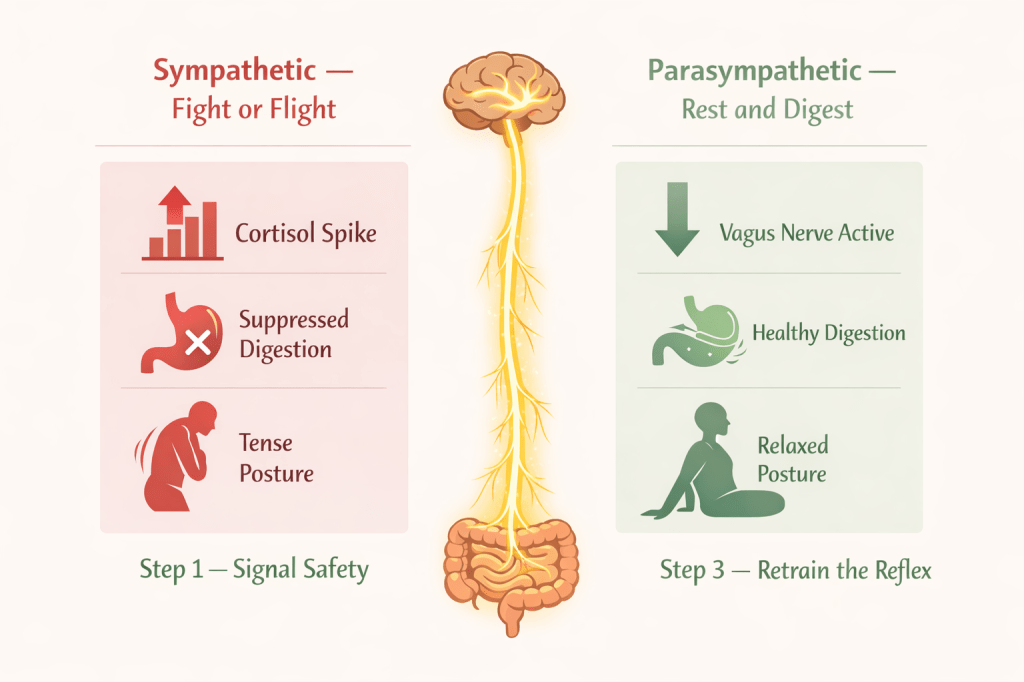
Your gut and your brain are in constant two-way communication through the vagus nerve — the longest nerve in your body, running from your brainstem all the way to your colon. Researchers at Johns Hopkins Medicine describe this two-way communication highway as so complex and autonomous that they call the gut’s nervous system the “second brain.”
When you are under chronic stress — even low-level background anxiety — your vagus nerve activity drops. Here is why.
Your autonomic nervous system runs on two competing branches. The sympathetic branch is your “fight-or-flight” system — activated by stress, it accelerates your heart rate, tenses your muscles, and shuts down non-essential functions like digestion. The parasympathetic branch is the opposite — and the vagus nerve is the primary parasympathetic pathway. When it is active, your heart slows, your body relaxes, and your gut gets the signal to move.
These two branches are largely reciprocal. When one activates, the other suppresses.
Chronic stress keeps your sympathetic system in a persistent low-level “on” state. This means your vagus nerve is correspondingly quieted, not switched off, but significantly dampened. The mechanism involves cortisol, your primary stress hormone. Research published in Frontiers in Human Neuroscience shows that prolonged cortisol elevation directly reduces heart rate variability (HRV) – the most reliable measurable marker of vagal tone. Lower HRV means weaker vagus nerve signaling. Weaker vagus nerve signaling means your gut receives less of the “it’s safe to digest” instruction it needs to move.
There is also a deeper layer described by Dr. Stephen Porges’ Polyvagal Theory – under sustained perceived threat, the nervous system can drop into what Porges calls a “dorsal vagal shutdown” state: a freeze or immobilization response where digestion essentially goes offline entirely. This is the physiological reality behind what many women with chronic constipation describe as their gut feeling “completely frozen” during periods of high anxiety.
In plain terms: when your brain perceives ongoing threat, even the quiet kind that comes from work stress, relationship tension, or simply dreading your morning bathroom routine, it keeps a small but constant stream of cortisol flowing. That cortisol suppresses vagal tone. Your gut stops receiving the “it’s safe to digest” signal. Motility slows. Everything backs up.
The vicious cycle: Anxiety suppresses vagus nerve activity → gut motility slows → constipation causes more anxiety → anxiety further suppresses the vagus nerve → constipation worsens. No supplement interrupts this loop from the outside. The interruption has to come from inside the nervous system.
This is what makes anxiety-driven chronic constipation,what doctors often diagnose as IBS-C, so resistant to standard treatments. The supplements address the gut. The real problem is the nervous system running it.
The One Thing That’s Different: A Nervous-System-First Approach
The approach that finally broke my 15-year cycle wasn’t a new supplement. It was changing the order of operations.
Instead of trying to force the gut to move, I started asking: “What does my nervous system need to feel safe enough to digest?”
This shifted everything. Here is what that looks like in practice.
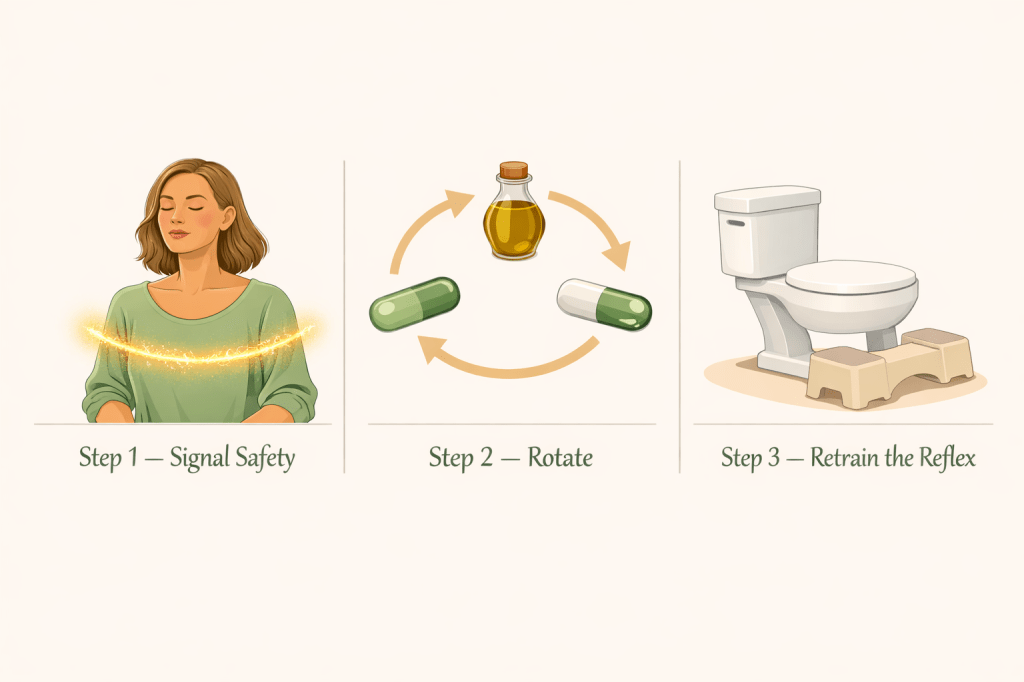
Step 1: Signal Safety Before You Take Anything
Before reaching for your morning supplement, spend 3–5 minutes activating your vagus nerve. This switches your physiology from “fight-or-flight” into “rest-and-digest” mode — the only state in which your gut will respond properly to anything you give it.
The method: 4-7-8 breathing. Inhale through your nose for 4 counts, hold for 7, exhale slowly through your mouth for 8. Repeat 4–5 times. The extended exhale is what stimulates vagal tone and drops your cortisol.
My personal tip: I do this while holding a warm cup of tea or coffee. The warmth and the breathing together create a powerful “safety signal” for my nervous system. It takes 5 minutes and it is the single most important thing I do every morning.
Step 2: Rotate Your Supplements — Don’t Stack Them Daily
Once your nervous system is primed, your supplements will actually work. But to prevent adaptation, you need to rotate them, not take the same thing every single day.
The rotation: Take Magnesium Citrate (200–400mg) for 4 days a week. On the other 3 days, use a tablespoon of high-quality olive oil or MCT oil first thing in the morning. Take probiotics at night, 3–4 times per week, not daily.
Why this works: Each supplement activates a slightly different mechanism. Magnesium draws water into the colon osmotically. Oil triggers the gastrocolic reflex through fat-stimulated bile release. Rotating between them keeps your enteric nervous system sensitive to both signals instead of adapting to and ignoring one.
Step 3: Retrain the Reflex With Consistency
Your defecation reflex is a neurological habit. Like all habits, it can be retrained — but it requires consistency over time, not heroic effort on any one day.
The practice: Go to the bathroom at the same time every morning, even if you feel no urge. Post-breakfast is ideal because eating triggers the gastrocolic reflex naturally. Use a footstool to raise your knees above your hips — this relaxes the puborectalis muscle and straightens the anorectal angle, making elimination significantly easier.
My personal tip: Don’t strain. Don’t force. Show up, breathe, and give your body 5–10 minutes. Some mornings nothing happens. That is fine. You are training a neurological rhythm, not performing a task. Consistency over weeks is what creates the reflex.
How Long Does This Take?
This is the question I get asked most often — and I want to answer it honestly.
Most people notice a difference within 7–14 days of consistent practice. Not dramatic overnight relief, but something more valuable: a pattern. The good days start to outnumber the bad ones. The anxiety around the morning routine begins to soften.
Full retraining of the gut-brain reflex takes 4–12 weeks depending on how long your constipation has been chronic and how dysregulated your nervous system is. The research on neuroplasticity is clear: the enteric nervous system can be retrained. It just requires repetition, not force.
What to expect week by week: Week 1–2: Nervous system begins to calm. Occasional easier mornings. Supplements feel more effective. Week 3–4: Pattern starts to stabilize. Consistent toilet time begins to feel natural. Week 5–8: Gut reflex strengthens. Supplement dependency decreases. Anxiety around digestion reduces. Week 9–12: New baseline established. Emergencies become rare instead of frequent.
Frequently Asked Questions
Why does my constipation get worse when I stop laxatives? Because your colon has learned to rely on the chemical signal instead of generating its own rhythm. This is the Lazy Bowel Effect — a form of enteric nervous system adaptation. It is temporary and reversible with the retraining approach described above, but it does require patience through the initial withdrawal period.
Is this approach safe to try alongside my current medication? The nervous system practices (breathwork, consistent toilet habits) are safe for everyone. For the supplement rotation, consult your doctor if you are on prescription medications, as magnesium can affect how some drugs are absorbed. This post is for educational purposes and is not medical advice.
I have anxiety but my doctor says my constipation is not IBS-C. Does this still apply? Yes. The vagus nerve connection between stress, anxiety, and gut motility exists regardless of your specific diagnosis. Any chronic constipation that worsens under stress or has been unresponsive to standard dietary changes is likely influenced by nervous system dysregulation.
Your Next Steps
If you are reading this and recognizing your own pattern, here is where to go next:
→ If you need relief right now: Emergency Constipation Relief: A 3-Step Science-Backed Plan
→ If you want the full rotation system: Why Constipation Remedies Stop Working (And My 3-Step Rotation Protocol)
→ If you want to understand the science: IBS-C 101: It’s Not a Gut Disease, It’s a Gut-Brain Communication Breakdown
The free 7-Day Vagus-Vital Starter Guide walks you through the nervous system foundation step by step — so you can stop the guesswork and start building a gut-brain rhythm that actually holds.
👉 Enter your email below to get instant free access.
Sources
- Johns Hopkins Medicine — The Brain-Gut Connection
- Polyvagal Institute — Polyvagal Theory (Stephen Porges)
- Frontiers in Human Neuroscience — Vagal Tone and Heart Rate Variability Research
- National Institutes of Health (NIH) — Magnesium and Digestive Health
- NIH National Library of Medicine — Enteric Nervous System and Gut Motility
Disclaimer: This post shares insights from my 15-year personal journey with chronic constipation and is for educational purposes only. It is not medical advice. Please consult your doctor before making any changes to your supplements, diet, or health routine.

 NeuroSpirit | Science-Backed IBS-C & Chronic Constipation RelieF
Leave a comment