
Last updated: April 5, 2026
Quick Summary: If you are in pain and haven’t pooped for days, don’t panic. This emergency reset uses a “Nervous System First” approach. The 10-Minute Fix: Perform 5 minutes of 4-7-8 breathing, take 200–400mg of Magnesium Citrate with warm water, and perform a clockwise abdominal massage.
If you’re reading this, you’re likely in a state of discomfort and anxiety. The urge to grab the strongest stimulant laxative on the shelf is overwhelming. You want relief, and you want it now.
However, for those with a high-stress lifestyle or IBS-C, aggressive stimulants often backfire. This guide offers a different path—one grounded in physiology and the gut-brain axis—to safely restart your digestion.
Why Standard Laxatives Often Fail for IBS-C
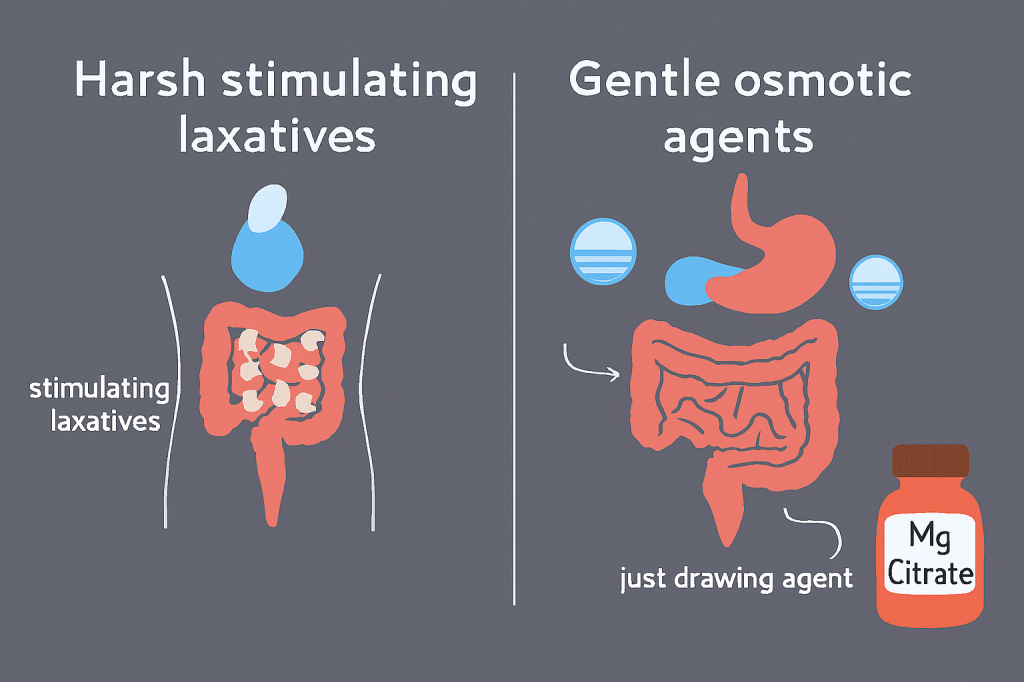
When you’re desperate, you might reach for stimulants like senna or bisacodyl. For many, these ignore the root cause:
- The “Freeze” Response: Chronic constipation is often a nervous system in “dorsal vagal shutdown.” Forcing a clenched system to contract with chemicals can be intensely painful.
- The Adaptation Trap: Your colon can become dependent on stimulants, leading to “lazy bowel syndrome.”
The NeuroSpirit Emergency Plan: Signal “Safety” to Restart Motility
Step 1: Immediate Nervous System Reset (The Vagus Nerve Hook)
Anxiety inhibits the Vagus Nerve, your body’s primary “rest-and-digest” highway. Before ingesting anything, you must lower the alarm signal.
- The Science: Studies in Frontiers in Human Neuroscience show that prolonged exhales increase vagal tone, promoting gut motility.
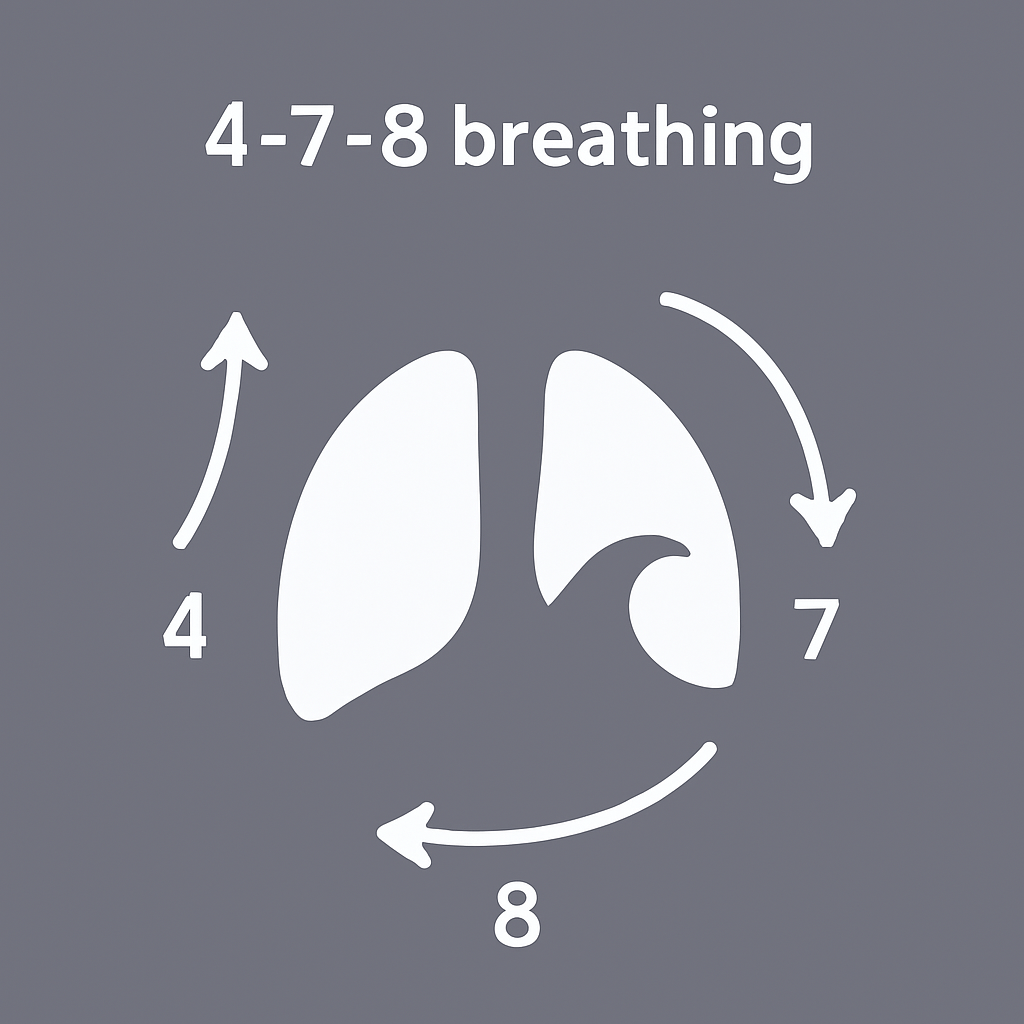
- Your Action: 4-7-8 Breathing. Inhale through your nose for 4 seconds, hold for 7, and exhale through your mouth for 8. Repeat for 5 minutes to unlock the “freeze” state of your gut.
Step 2: The Osmotic Nudge (Hydrate the Stool)
Instead of stimulants, use osmotic agents that draw water into the colon to soften stool naturally.
- Magnesium Citrate: A dose of 200–400mg with a large glass of warm water is the gold standard. It acts as a natural muscle relaxant for the enteric nervous system.
- Electrolyte Support: Drink warm water with lemon and a pinch of sea salt. Hydration is critical for the electrical signals that trigger peristalsis (muscle contractions).
- For a complete guide to choosing the right type and dose for IBS-C, see our detailed article: Magnesium for Constipation & IBS-C: Citrate vs. Glycinate.
Step 3: Physical Peristalsis Stimulation
Combine your internal work with external “manual” help to move the blockage.
- Abdominal Massage: Apply firm but gentle pressure and massage in a clockwise circle around your navel. This follows the natural path of the ascending, transverse, and descending colon.
- The Squat Position: Use a footstool to elevate your knees above your hips. This relaxes the puborectalis muscle, straightening the path for elimination.
Your Next Meal: The “Gut-Grease” Principle
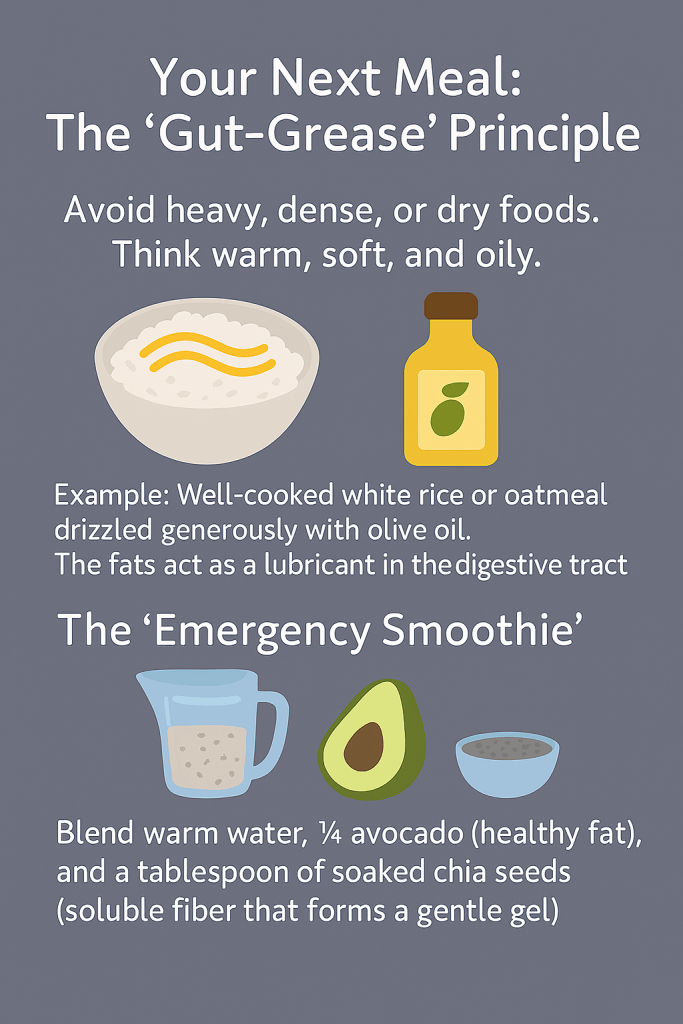
Avoid heavy, dry, or high-fiber foods immediately after a flare-up. Think warm, soft, and oily.
- The Lubricant: Well-cooked white rice or oatmeal drizzled generously with high-polyphenol olive oil or MCT oil.
- The Emergency Smoothie: Blend warm water, ¼ avocado (healthy fat), and a tablespoon of soaked chia seeds.
Emergency constipation relief is the rapid resolution of acute constipation — typically within 30 minutes to 6 hours —
using osmotic or stimulant laxatives, targeted hydration, or nervous system interventions that activate the gastrocolic
reflex. Effective emergency relief addresses both the physical blockage and the gut-brain tension that commonly worsens
the episode.
Laxative Comparison: Stimulant vs. Osmotic vs. Nervous System Approach
| Stimulant Laxatives | Osmotic Laxatives | Nervous System Approach | |
|---|---|---|---|
| Examples | Bisacodyl (Dulcolax), Senna | Magnesium citrate, MiraLAX, Lactulose | 4-7-8 breathing, vagal stimulation, gut-directed hypnotherapy |
| Mechanism | Triggers nerve signals in the colon wall to force muscular contractions | Draws water into the intestines to soften stool and stimulate movement | Activates the parasympathetic nervous system to restore gut motility suppressed by stress |
| Speed | Fast: 6–12 hours | Moderate: 30 min–6 hours (acute); 1–3 days (maintenance) | 15–60 minutes for acute nervous system shift; weeks for lasting motility improvement |
| Dependency Risk | High — frequent use can damage enteric nerves and cause rebound constipation | Low to moderate — safe short-term; electrolyte monitoring needed for extended use | None — builds long-term gut-brain resilience |
| IBS-C Suitability | Poor — cramping and gut hypersensitivity make stimulants poorly tolerated; emergency use only | Good — first-line recommendation from most gastroenterologists for IBS-C | Excellent — directly addresses the gut-brain dysregulation that drives IBS-C; no side effects |
| Best Use Case | One-time acute relief when osmotic options have failed | Acute relief and short-term management of chronic constipation | Long-term IBS-C management; combine with osmotic laxatives during acute episodes |
Does this sound like your story?
Everything failed. Then I stopped treating my gut.
I put together a free 7-day guide that walks through exactly what finally worked for me after 15 years of IBS-C — a nervous system reset that has nothing to do with fiber, diets, or supplements that stop working.
👉 Enter your email below and I’ll send it straight to you. Free.
Frequently Asked Questions
How long does magnesium citrate take to work?
Magnesium citrate typically produces a bowel movement within 30 minutes to 6 hours of taking it. It works as an osmotic laxative, drawing water into the intestines to soften stool and stimulate movement. Peak effect usually occurs around 3 hours. Taking it on an empty stomach with a full glass of water speeds onset. If no result occurs after 6 hours, do not double-dose — contact a healthcare provider.
Is magnesium citrate safe to take every day?
No. Magnesium citrate is safe for occasional, short-term use — generally no more than one week at a time without medical supervision. Daily use can cause electrolyte imbalances (particularly low potassium and sodium), dependency, and rebound constipation when stopped. For people with kidney disease or heart conditions, even short-term use requires a doctor’s approval. For chronic constipation, a daily magnesium glycinate supplement (a gentler form) is a safer long-term option.
Why does constipation get worse with anxiety?
Anxiety activates the sympathetic nervous system — the “fight-or-flight” response — which diverts blood flow away from the digestive tract and slows peristalsis (the muscular contractions that move stool). At the same time, anxiety elevates cortisol, which disrupts the gut microbiome and reduces motility. For people with IBS-C, this creates a reinforcing loop: constipation causes anxiety, anxiety worsens constipation. This is why nervous system regulation is a clinically recognized component of IBS-C treatment, not just a wellness add-on.
What is 4-7-8 breathing, and how does it help digestion?
4-7-8 breathing is a structured breathwork technique where you inhale for 4 counts, hold for 7, and exhale for 8. The extended exhale activates the parasympathetic nervous system (the “rest-and-digest” state), which counteracts stress-driven motility shutdown. For constipation, diaphragmatic movement during the technique also creates gentle mechanical pressure on the colon. Research on slow, controlled breathing shows measurable reductions in GI symptom severity for people with functional bowel disorders, including IBS-C.
What is the difference between stimulant and osmotic laxatives for IBS-C?
Stimulant laxatives (like bisacodyl or senna) trigger nerve signals in the colon wall to force muscular contractions. They work fast — often within 6–12 hours — but carry a higher risk of cramping, urgency, and long-term nerve damage with frequent use, making them a poor fit for IBS-C’s hypersensitive gut. Osmotic laxatives (like magnesium citrate, MiraLAX, or lactulose) pull water into the bowel to soften stool and gently stimulate movement — slower but significantly better tolerated for IBS-C. Most gastroenterologists recommend osmotic laxatives as the first-line approach for IBS-C, reserving stimulants for acute, one-time relief only.
Stop the Emergency Cycle Forever
If these emergencies are becoming a pattern, your body is likely adapting to your remedies. A “one-size-fits-all” supplement routine eventually stops working because the nervous system learns to bypass it.
To break this cycle, you need a rotation that prevents adaptation.
→ Read Next: Why Every Constipation Remedy Stops Working (The Science of Adaptation)
→ Ready to stop the emergency cycle? Read my guide on the Neuro-Rotation Method: Why Constipation Remedies Stop Working (And My 3-Step Rotation Protocol to Fix It)
If nothing has worked — this is why.
“Everything Failed. Then I Stopped Treating My Gut.”
Free 7-day nervous system reset guide for women with chronic constipation whose doctors have run out of answers. The exact approach that broke my 15-year cycle — and the science explaining why it works.
👉 Enter your email for instant free access.
About the Author
Ting is a gut-brain health writer and the founder of NeuroSpirit, a resource for people navigating the intersection of the nervous system and digestive health. She has managed IBS-C herself for over 15 years, which drives her commitment to translating clinical research on the gut-brain axis into practical, experience-tested strategies. Her writing bridges the gap between gastroenterology, nervous system regulation, and daily life for people who have been told their constipation is “just stress.”
Disclaimer: This post is for educational purposes based on my 15-year journey with IBS-C. It is not medical advice. Always consult your doctor before starting new supplements.

 NeuroSpirit | Science-Backed IBS-C & Chronic Constipation RelieF
Leave a reply to Why Nothing Works for Your Constipation (And the One Thing That’s Different) – NeuroSpirit | Science-Backed IBS-C & Chronic Constipation RelieF Cancel reply