
Last updated: April 5, 2026
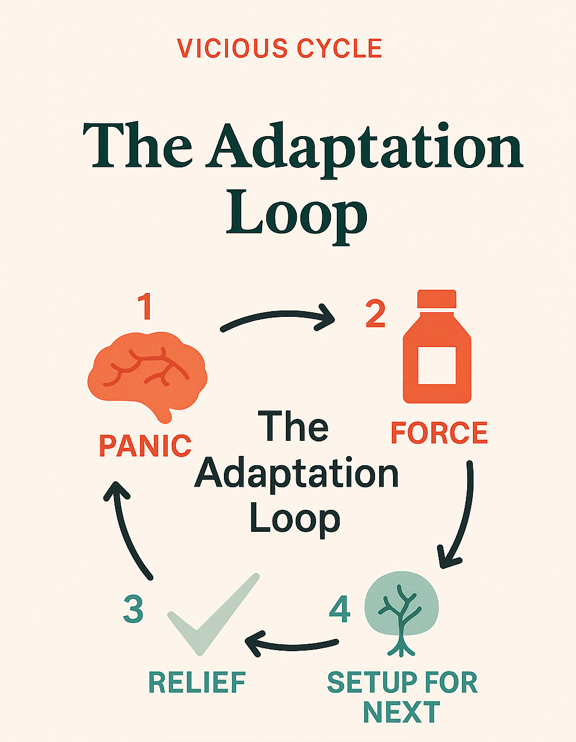
What is a constipation emergency cycle? A constipation emergency cycle is a repeating pattern where acute constipation triggers nervous system panic, emergency laxatives provide temporary relief, but the underlying gut-brain dysregulation remains unchanged — setting up the next episode within days or weeks. Breaking it requires nervous system retraining, not stronger laxatives.
If you’re caught in a loop of desperate searches, emergency laxatives, and temporary relief—only to find yourself back in the same panicked place weeks later—you’re not failing. You’re stuck in a biological adaptation loop.
This isn’t just about a sluggish gut. It’s about a nervous system that learns to associate your colon with danger, a gut-brain axis stuck on high alert, and well-intentioned remedies that eventually become part of the problem.
This post will show you why that frantic, middle-of-the-night cycle repeats and—more importantly—give you a science-backed plan to break free from it for good.
The Vicious Cycle: How One Emergency Plants the Seed for the Next
Every acute constipation episode is more than a physical event; it’s a traumatic learning experience for your nervous system. Here’s how a single emergency can program the next one:
- The Crisis: You’re in pain, bloated, and panicked. Your nervous system activates the “fight-or-flight” (sympathetic) state.
- The Emergency “Fix”: In desperation, you might use a strong stimulant laxative or an enema. While it provides relief, it does so by forcibly overstimulating a system already in shutdown. This reinforces the “danger” signal.
- The Aftermath: Your body clears the backlog, but the underlying neurological state—the “freeze” response governed by your vagus nerve—remains unchanged. As I explored in The Vagus Nerve Blockade: Why Chronic Stress Literally Stops Your Digestion, a stressed nervous system directly inhibits gut motility. Research published in Neurogastroenterology & Motility found that patients with IBS-C show significantly lower vagal tone (measured by heart rate variability) compared to healthy controls — confirming that nervous system dysregulation is a measurable, physiological feature of the condition, not a psychological label.
- The Setup: With motility still impaired and the gut-brain axis primed for alarm, the physical conditions for another backup begin almost immediately. The memory of the last crisis creates anticipatory anxiety, further tightening the loop. This is the essence of IBS-C 101: It’s Not a Gut Disease, It’s a Gut-Brain Communication Breakdown.
This cycle explains why simply managing each crisis with a one-time emergency plan isn’t enough for long-term healing. While a calm, step-by-step protocol is essential for acute relief, it doesn’t rewrite the nervous system’s learned alarm response. You must address the deeper programming itself.
Why Your “Between-Emergency” Strategies Stop Working
In the calm between storms, you try to be proactive. You take magnesium, probiotics, and eat more fiber. Yet, the emergency still returns. This is the frustrating science of adaptation at play.
Your body is designed to maintain balance (homeostasis). When you introduce a consistent, strong signal—like a daily osmotic agent—your smart physiology adapts to it. The receptors in your gut become less responsive. Studies on enteric nervous system adaptation show that receptor downregulation can occur within 14–21 days of consistent daily stimulation — explaining why most constipation supplements plateau within 2–3 weeks of daily use. What worked at 200mg of magnesium now requires 400mg. This is a core reason Why Every Constipation Remedy Stops Working.
The problem isn’t the tools; it’s using them as constant crutches on a system that hasn’t been taught how to walk on its own again. They manage the symptom in the colon but don’t reset the master signal from the brain.
The 3-Part Framework to Break the Cycle for Good
Breaking free requires shifting from crisis management to system retraining. This framework targets the root: your nervous system.
Phase 1: Reframe the Emergency (Your Mental Reset)
The next time you feel an emergency coming on, pause. Before you reach for anything, acknowledge this is a signal, not a sabotage.
- Action: Use the calm, science-backed emergency steps but with a new intention. As you do the 4-7-8 breathing, mentally affirm: “I am safely clearing this backlog so I can begin retraining my system.” This begins to dissociate the act of relief from panic.
Phase 2: Build Daily “Safety” Signals (The Foundation)
This is the non-negotiable work between crises. Your goal is to consistently signal “safety” to your gut-brain axis to lower its default alarm setting.
- Action 1 – Vagus Nerve Toning: For 5 minutes each morning, practice diaphragmatic breathing. This isn’t optional; it’s like brushing your teeth for your nervous system. It directly stimulates the vagus nerve, promoting the “rest-and-digest” state.
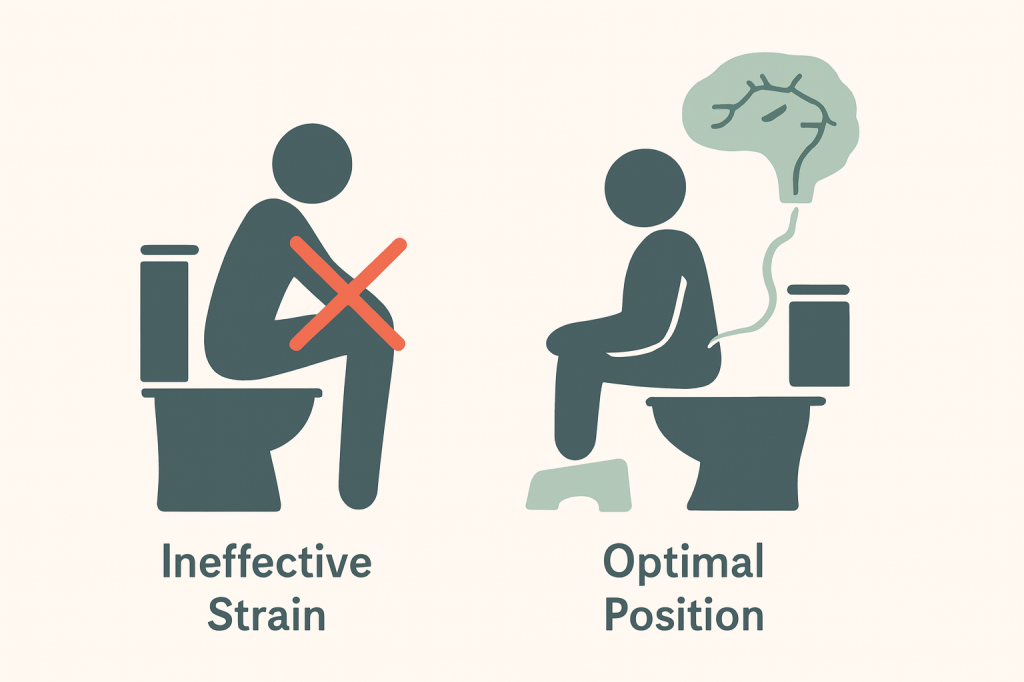
- Action 2 – Defecation Retraining: Go to the bathroom at the same time every day (post-breakfast is ideal). Sit with your knees above your hips (using a squatty potty can help). Breathe deeply and do not strain. You are teaching your brain-gut axis a new, calm routine. This is especially critical because chronic straining and anxiety can lead to pelvic floor dysfunction, where the muscles you use to go actually tighten when they should relax. Retraining creates a pattern of ease, not force.
Phase 3: Use Tools Strategically, Not Constantly (The Taper)
Your supplements and diets are supports, not saviors. Use them to facilitate the new nervous system training.
- Action: If you use magnesium, shift to a cyclical protocol (e.g., 3-4 days on, 3-4 days off). On “off” days, double down on your breathing and mindfulness. This prevents adaptation and allows you to observe your body’s innate rhythm returning. View probiotics as an 8-week course to support microbiome diversity, not a permanent pill.
Your First Week: A Sample Protocol to Start Today
| Day | Morning (5 min) | With Breakfast | Evening (5 min) | Supplement Notes |
|---|---|---|---|---|
| 1-3 | Diaphragmatic Breathing | Go to bathroom, no pressure | Gentle Abdominal Massage | Take your usual magnesium. |
| 4-7 | Diaphragmatic Breathing + 1 min of Humming | Go to bathroom, no pressure | 4-7-8 Breathing | Consider a “low” or “off” day for magnesium. Observe. |
The Goal This Week: Consistency in signaling, not perfection in outcome. The point is to build the habit of safety.
When to Seek Specialized Help
If you implement this for 4 weeks and see no change in baseline anxiety or gut function, it’s time to investigate deeper layers. As outlined in the diagnosis map for chronic constipation, persistent cycles may point to SIBO, pelvic floor dyssynergia, or other complex factors that require a skilled practitioner to diagnose and treat alongside nervous system work.
Does this sound like your story?
Everything failed. Then I stopped treating my gut.
I put together a free 7-day guide that walks through exactly what finally worked for me after 15 years of IBS-C — a nervous system reset that has nothing to do with fiber, diets, or supplements that stop working.
👉 Enter your email below and I’ll send it straight to you. Free.
The Path Forward: From Surviving Cycles to Sustained Rhythm
Healing isn’t about never having a slow day again. It’s about changing the conversation between your brain and your gut. It’s moving from a state of constant threat and emergency overrides to one of trust and rhythmic function.
You break the cycle not by fighting each fire with a bigger hammer, but by teaching your body that the house is no longer in danger. The real remedy is safety.
Frequently Asked Questions
Why do constipation emergencies keep coming back even when I treat them?
Because most treatments address the symptom — the backed-up colon — without addressing the cause: a nervous system stuck in “fight-or-flight” mode. When your vagus nerve activity is chronically suppressed by stress, your gut’s natural motility reflex stays dampened. Each emergency provides physical relief but leaves the neurological alarm pattern intact, making the next episode almost inevitable within days to weeks.
How long does it take to break the constipation emergency cycle?
Most people notice a reduction in emergency frequency within 2–4 weeks of consistent nervous system retraining — daily 4-7-8 breathing, consistent morning bathroom timing, and strategic supplement rotation. Full cycle-breaking, where emergencies become rare rather than recurring, typically takes 6–12 weeks. The nervous system needs repetition to unlearn a deeply practiced alarm pattern.
Is using a stimulant laxative during an emergency making things worse long-term?
Yes, with regular use. A single emergency use of a stimulant laxative (like bisacodyl or senna) is unlikely to cause lasting harm. But repeated use trains your colon to wait for a chemical signal rather than generate its own contractions — a pattern called Lazy Bowel Syndrome. It also reinforces the nervous system’s “danger” association with your gut, deepening the anxiety-constipation loop. Osmotic agents (magnesium citrate) are a safer emergency option for IBS-C.
What does “anticipatory anxiety” mean for IBS-C, and why does it matter?
Anticipatory anxiety is the dread you feel about constipation before it even happens — the morning panic when you wake up wondering if today will be a bad day. For IBS-C sufferers, this pre-event anxiety is physiologically significant: it activates the sympathetic nervous system before the gut has even had a chance to function normally, suppressing vagal tone and slowing motility before breakfast. This is why the morning routine — breathing before checking in with your gut — is clinically meaningful, not just a wellness habit.
Sources
- Johns Hopkins Medicine — The Brain-Gut Connection
- Polyvagal Institute — Polyvagal Theory: Stephen Porges
- Frontiers in Human Neuroscience — Vagal Tone, HRV and Gut Motility
- Neurogastroenterology & Motility — IBS-C and Autonomic Nervous System Function
- NIH National Library of Medicine — Enteric Nervous System Adaptation and Receptor Downregulation
- NIH Office of Dietary Supplements — Magnesium: Health Professional Fact Sheet
If nothing has worked — this is why.
“Everything Failed. Then I Stopped Treating My Gut.”
Free 7-day nervous system reset guide for women with chronic constipation whose doctors have run out of answers. The exact approach that broke my 15-year cycle — and the science explaining why it works.
👉 Enter your email for instant free access.
Recommended Next Reads on Neurospirit:
- Morning Anxiety & Constipation: How I Used My Breath to Calm My Gut After 15 Years – A personal story applying these principles.
- When Your Gut is Stuck, So Is Your Mind: The Constipation-Anxiety Loop – Delving deeper into the psychological cycle.
About the Author
Ting is a gut-brain health writer and the founder of NeuroSpirit, a resource for people navigating the intersection of the nervous system and digestive health. She has managed IBS-C herself for over 15 years, which drives her commitment to translating clinical research on the gut-brain axis into practical, experience-tested strategies. Her writing bridges the gap between gastroenterology, nervous system regulation, and daily life for people who have been told their constipation is “just stress.”
Disclaimer: This post is for educational purposes based on my 15-year journey with IBS-C. It is not medical advice. Always consult your doctor before starting new supplements.

 NeuroSpirit | Science-Backed IBS-C & Chronic Constipation RelieF
Leave a reply to Why Laxatives Make Constipation Worse Over Time — The Rebound Effect Nobody Warns You About – NeuroSpirit | Science-Backed IBS-C & Chronic Constipation RelieF Cancel reply