

Last updated: April 27, 2026
Quick Summary: Constipation doesn’t just cause physical discomfort — it actively raises your anxiety and can trigger panic through three documented gut-brain mechanisms. This post explains exactly why, and what to do about both directions of the cycle at once.
You’ve been backed up for days. The bloating is relentless. And now your heart is racing, a wave of dread has settled over you, and you can’t explain why.
You’re wondering: is my gut doing this to my mind?
Yes. Completely, physiologically, measurably — yes. And almost nobody explains this direction of the relationship.
What Is the Constipation-Anxiety Cycle?
The constipation-anxiety cycle is a bidirectional loop: anxiety suppresses gut motility through the vagus nerve — causing constipation — while constipation simultaneously disrupts serotonin production, alters gut microbiome balance, and generates physical discomfort that feeds directly back into the brain’s threat system, raising anxiety and lowering the threshold for panic.
A 2025 study in Frontiers in Psychiatry of 9,126 U.S. adults found that 41.4% of people with constipation also had anxiety — compared to 26% of those without. That’s not coincidence. That’s biology.
The Three Ways Constipation Drives Anxiety
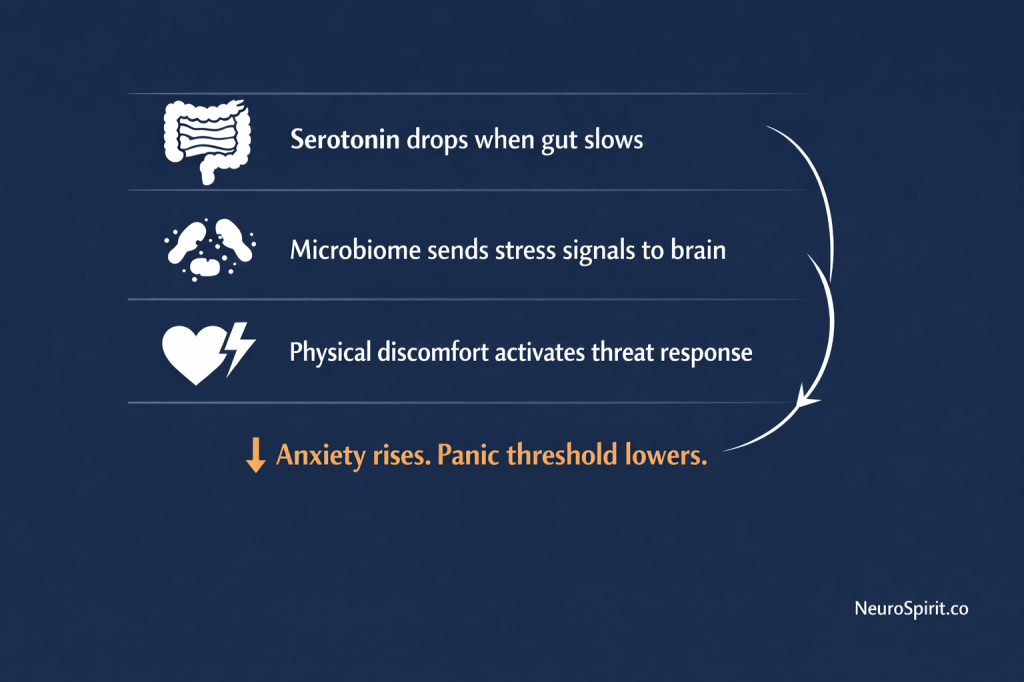
1. Disrupted serotonin production 90–95% of your body’s serotonin is made in the gut, not the brain. When gut motility slows, serotonin production from intestinal cells drops. Less serotonin means a lower emotional resilience and a higher baseline anxiety — which is why you feel inexplicably flat or dreadful on bad constipation days even when nothing stressful has happened.
2. Microbiome stress signals When stool sits in the colon for extended periods, the microbial environment shifts. Beneficial bacteria that produce calming neurotransmitter precursors decline. The gut sends altered signals up the vagus nerve that the brain registers as threat — contributing directly to anxiety, low mood, and in sensitised nervous systems, panic-level responses.
3. The physical discomfort threat loop Your amygdala doesn’t distinguish well between emotional threats and physical ones. Chronic bloating and abdominal pressure are registered as real threats, elevating cortisol, tensing muscles, and raising heart rate. For a nervous system already sensitised by anxiety, this physical threat signal can breach the threshold for panic — racing heart, chest tightness, overwhelming dread. The panic then activates fight-or-flight, which suppresses gut motility further, and the cycle continues.
My Experience With This Loop
In my tenth year of IBS-C, seven days backed up, sitting at my desk, my heart started racing and a wave of pure dread hit me from nowhere. I thought something was seriously wrong beyond the constipation.
I was right that something was wrong. I was wrong that it was separate from the constipation.
Seven days of slow gut transit had suppressed my serotonin baseline, shifted my microbiome, and kept physical discomfort signals firing into an already-sensitised nervous system. The panic wasn’t alongside the constipation. It was the constipation, expressed through every system in my body at once.

What Actually Helps — Treat the Shared Root
Because both conditions share the same root — a nervous system in chronic sympathetic dominance — addressing the nervous system works on both simultaneously.
First: the extended exhale. Before reaching for a laxative, do 6 slow breaths — inhale 4 counts, exhale 6–8 counts. This directly activates the vagal brake and shifts your gut into a more receptive state within minutes. A gut in fight-or-flight responds poorly to laxatives — cramping, urgency, incomplete relief. A gut in parasympathetic state responds smoothly.
Then: gentle physical support. A warm drink triggers the gastrocolic reflex. Magnesium citrate powder in warm water provides osmotic support in a gut now ready to receive it. A footstool under your feet in the bathroom removes the mechanical obstacle that makes elimination harder.
Long-term: daily nervous system work. Consistent morning breathing, nightly magnesium glycinate, and a regular bathroom appointment at the same time each day rebuild vagal tone over weeks — which raises your serotonin baseline, improves microbiome balance, and gradually breaks the cycle at its root.
Frequently Asked Questions
Can constipation physically cause panic attacks? Yes — through the three mechanisms above. When constipation is prolonged, suppressed serotonin, microbiome stress signals, and physical discomfort activating the amygdala can collectively breach the panic threshold in sensitised nervous systems. The panic is being actively generated by the physiological state constipation creates — not appearing by coincidence alongside it.
Why do I feel such dread and doom when I’m badly constipated? This is the serotonin mechanism. Several days of slow gut motility measurably reduces serotonin signals your brain receives. The dread on bad constipation days is biochemically real — not catastrophising. It improves when gut motility improves, which is why nervous system work matters more than trying to manage the mood symptoms directly.
Should I treat the anxiety or the constipation first? Neither — treat the nervous system first. Both share the same root. Extended exhale breathing, consistent morning routine, and magnesium glycinate as a nightly foundation work on both directions simultaneously through the shared gut-brain mechanism.
Your Next Steps
→ The morning routine that addresses both directions: Why I’m Constipated Every Morning — And the Nervous System Fix That Finally Worked
→ The vagus nerve mechanism explained: Vagus Nerve and Constipation: How Chronic Stress Physically Shuts Down Your Gut
→ For emergency days: Haven’t Pooped in Days? A 3-Step Science-Backed Emergency Plan
Does this sound like your story?
Everything failed. Then I stopped treating my gut.
I put together a free 7-day guide that walks through exactly what finally worked for me after 15 years of IBS-C — a nervous system reset that has nothing to do with fiber, diets, or supplements that stop working.
👉 Enter your email below and I’ll send it straight to you. Free.
Sources
- Huang, Y. et al. (2025). Frontiers in Psychiatry. Link
- Yano, J.M. et al. (2015). Indigenous bacteria regulate host serotonin biosynthesis. Cell. Link
- Johns Hopkins Medicine — The Brain-Gut Connection. Link
About the Author
Ting is a gut-brain health writer and the founder of NeuroSpirit, a resource for people navigating the intersection of the nervous system and digestive health. She has managed IBS-C herself for over 15 years, which drives her commitment to translating clinical research on the gut-brain axis into practical, experience-tested strategies. Her writing bridges the gap between gastroenterology, nervous system regulation, and daily life for people who have been told their constipation is “just stress.”
Disclaimer: For educational purposes only. Not medical advice. Consult your doctor before changing your supplement or health routine.

 NeuroSpirit | Science-Backed IBS-C & Chronic Constipation RelieF
Leave a comment